How Often Should You Clean Your Oriental Rug?
How often should you clean an Oriental rug? Learn the ideal cleaning schedule based on fiber type, traffic, and home conditions to preserve your rug's beauty.
Read MoreFree Pickup & Delivery (8' x 10'+, Metro Atlanta) | 15% Off Drop-Off Service
What fringe work, binding, reweaving, and moth damage repair really cost — and how to tell if your rug is worth fixing.
Most area rug repairs cost between $150 and $800. Small jobs like securing loose fringe or re-wrapping a frayed side cord often land under $200. Hand reweaving a hole in a fine Oriental rug can run well past $1,000.
The spread is wide because rug repair is hand work. A technician is rebuilding the rug knot by knot, matching wool color and yarn thickness as they go. Two rugs with the same size hole can price very differently.
This guide breaks down what each type of repair typically costs, what pushes your quote up or down, and how to decide whether fixing a rug makes more sense than replacing it.
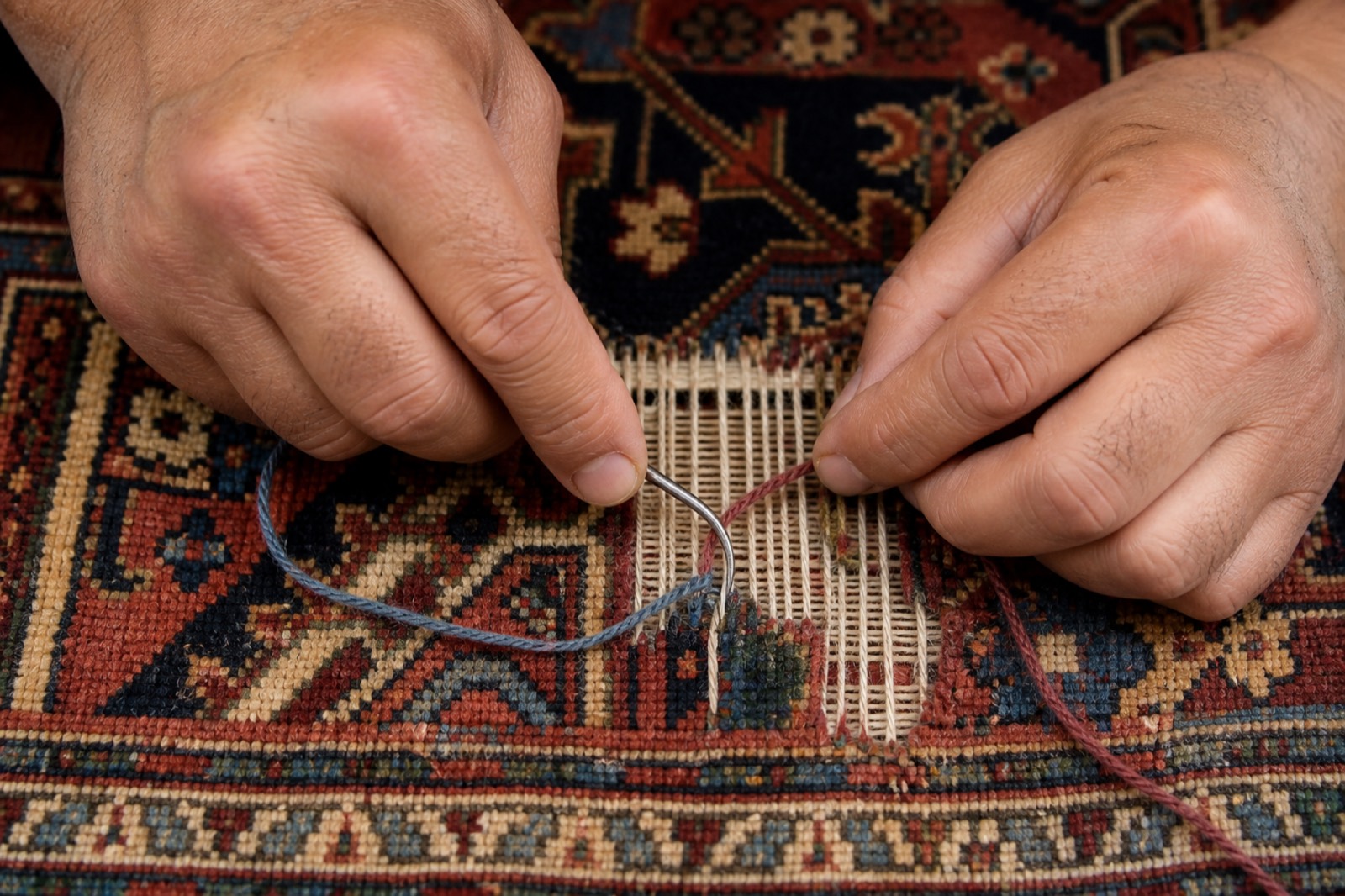
These are typical market ranges for professional rug restoration, not a fixed price list. Hand work is quoted after a technician sees the rug — which is why our evaluations and quotes are free.
Rug repair is not one service. It is a set of very different hand techniques, each priced its own way. Here is what the common ones typically run.
| Repair Type | What It Fixes | Typical Cost Range |
|---|---|---|
| Fringe stabilizing | Loose or unraveling end knots | $50 – $300 |
| Fringe replacement | Worn-away or missing fringe | $10 – $30 per linear foot |
| Side cord / overcasting | Frayed or split rug edges | $5 – $20 per linear foot |
| Binding or serging | Machine-made rug edges | $3 – $12 per linear foot |
| Small hole reweaving | Coin-sized holes and burns | $150 – $400 |
| Large-area reweaving | Missing sections, pet chewing | $500 – $1,500+ |
| Moth damage repair | Grazed pile and larval damage | Treatment + repair, quoted together |
| Pile shearing and blending | Uneven or crushed pile | $75 – $250 |
A quick note on the vocabulary. Overcasting means hand-wrapping yarn around the rug's outer edge so the side cord stops unraveling. Reweaving means rebuilding the foundation — the warp and weft threads underneath — and then knotting new pile into it. Our complete rug repair and restoration guide walks through each technique in more detail.
Fringe is not decoration. On a hand-knotted rug, the fringe is the warp — the structural threads the entire rug is tied onto. When fringe wears away, the knots at the end of the rug start letting go.
Because that damage runs along the rug's width, the work is measured in linear feet. A 9' x 12' rug with both ends failing means 18 feet of hand work. At $10 to $30 per foot, that is a meaningful job.
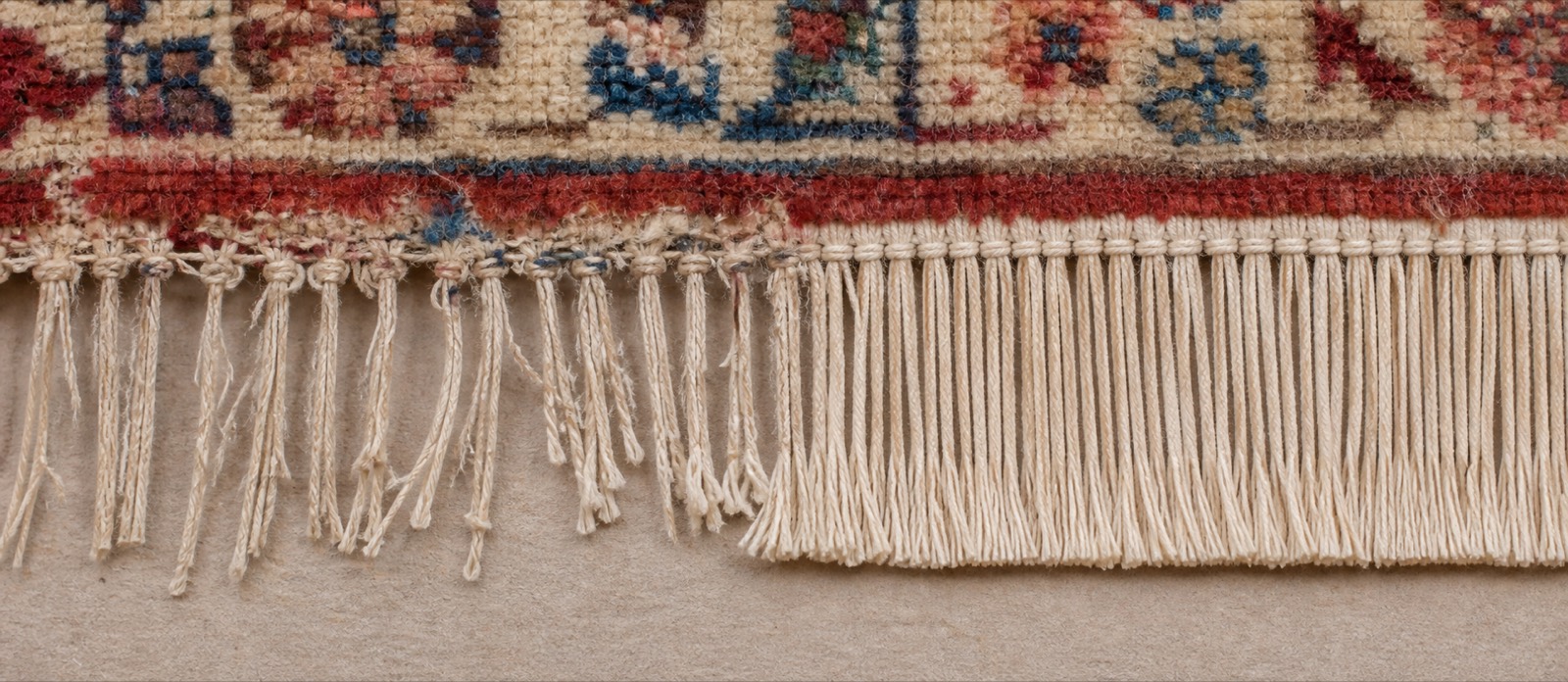
The same rug end, damaged and restored. Edge work is measured in linear feet, which is why the size of the rug matters as much as the severity.
If the fringe is thinning but the end knots are intact, a technician can secure the row and stop the unraveling. That is the cheapest fringe outcome there is. Wait another year and the same rug may need full fringe replacement instead.
New fringe can be machine-sewn onto the rug's end, or hand-knotted into the original foundation. Sewn fringe costs noticeably less and looks fine on decorative rugs. Hand-knotted fringe preserves the value of a fine piece and costs more accordingly.
The selvedge, or side cord, is the wrapped edge running down the length of the rug. Vacuum beater bars and furniture legs chew through it slowly. Catching it early keeps the job in the overcasting range instead of the reweaving range.
Reweaving is the closest thing rug care has to surgery. The technician rebuilds the missing foundation first, then ties new knots row by row to match the surrounding pattern.
A single square inch of a finely knotted rug can hold several hundred knots. Each one is placed by hand. That is why a hole the size of a quarter can take hours, and why price tracks knot density more than it tracks the size of the hole.
Color matching adds to the work. Wool from a dye lot woven decades ago has aged in sunlight and washing. A good repair uses yarn dyed to match the rug as it looks today, not as it looked when it was new.
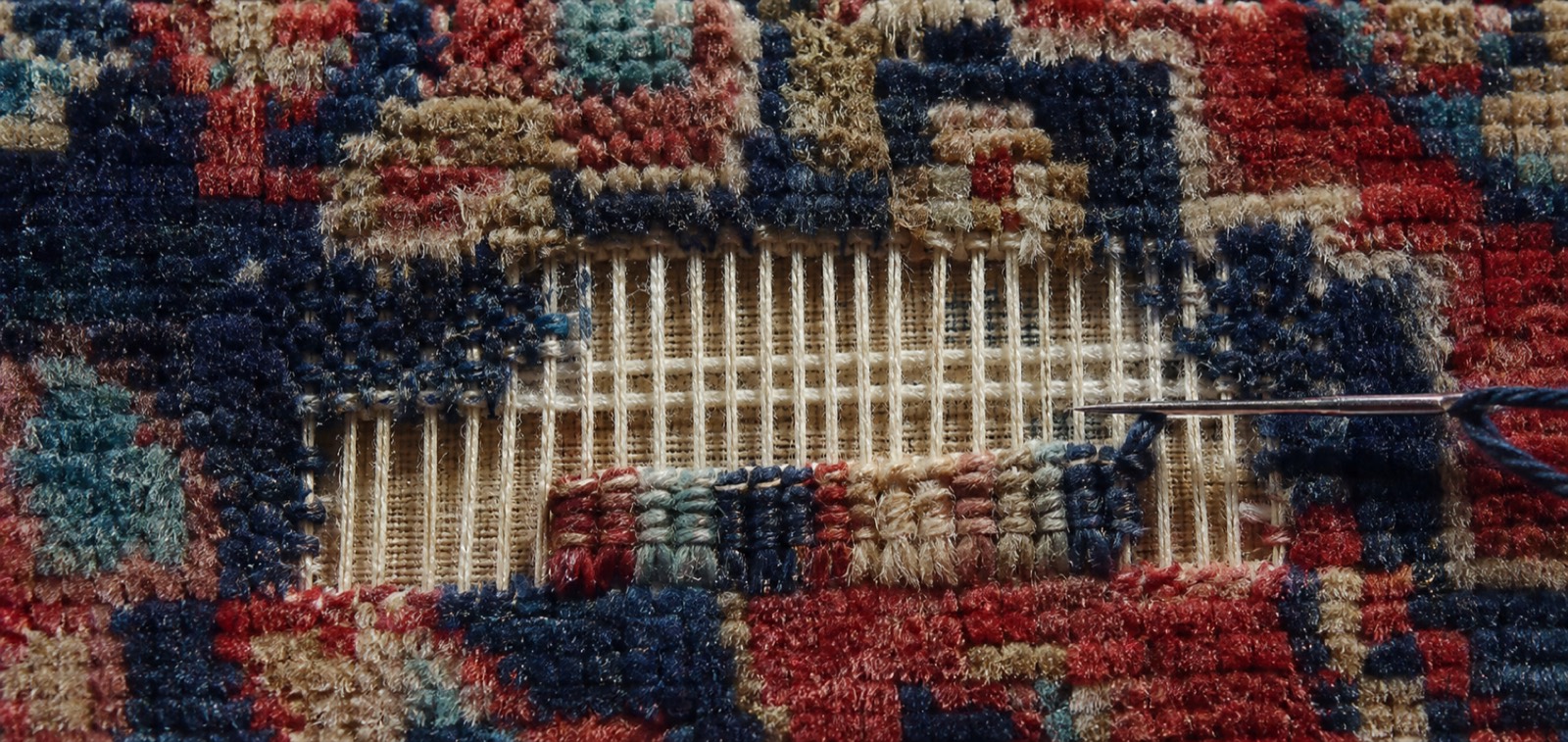
A reweave starts underneath: new warp and weft threads rebuild the foundation before a single knot of pile goes back in.
Antique pieces have their own rules, and not every old rug should be rewoven back to showroom condition. Our guide on repairing antique rugs covers when conservation beats restoration, and our service page for rug repair and restoration in Atlanta shows the kinds of damage we take on.
Hand-knotted rugs are repaired knot by knot. Machine-made and tufted rugs are repaired with patching, binding, and backing work, which is faster and cheaper. If you are unsure which you own, our guide to identifying quality rugs shows what to look for on the back.
Wool is forgiving. Silk is not. Silk yarn is expensive, harder to source in a matching color, and slower to work with, so silk repairs carry a premium. Rugs with unstable dyes may also need a spot test and dye stabilizing before anything else happens.
One hole is a contained job. Scattered damage across a whole border is many small jobs in a row. Technicians quote by the hours the work will take, so total affected area matters more than the worst single spot.
Moths and pets leave more than a hole behind. Larvae and eggs must be eliminated with professional moth treatment or the new wool becomes their next meal. Urine has to be flushed from the foundation with pet urine removal before repair, since dried salts weaken the fibers around the repair area.
Repairs are done on a clean rug. Grit in the foundation abrades new yarn, and colors cannot be matched accurately against a dirty surface. Most restoration jobs start with a full wash, so budget for professional rug cleaning alongside the repair.
There is a real difference between a structural fix that stops the damage and a museum-grade repair no one can find. Both are valid. Tell your technician which outcome you want, because it changes the hours and therefore the price.
Use a simple test. Compare the repair quote to what the rug would cost to replace with something of equal quality. If repair comes in under half of that, it is almost always the better move.
One more thing worth weighing: a well-made rug that gets repaired and washed on schedule can outlast its owner. A quality rug pad and regular Oriental and Persian rug cleaning are the cheapest repairs you will ever buy, because they prevent the expensive ones.
Nearly every expensive repair we see started as a cheap one that someone put off. An annual look at the ends and edges of your rug costs nothing and catches most of it.
No honest shop can price hand work over the phone without seeing the rug. What a good shop can do is tell you the likely range quickly, and confirm it in writing after inspection.
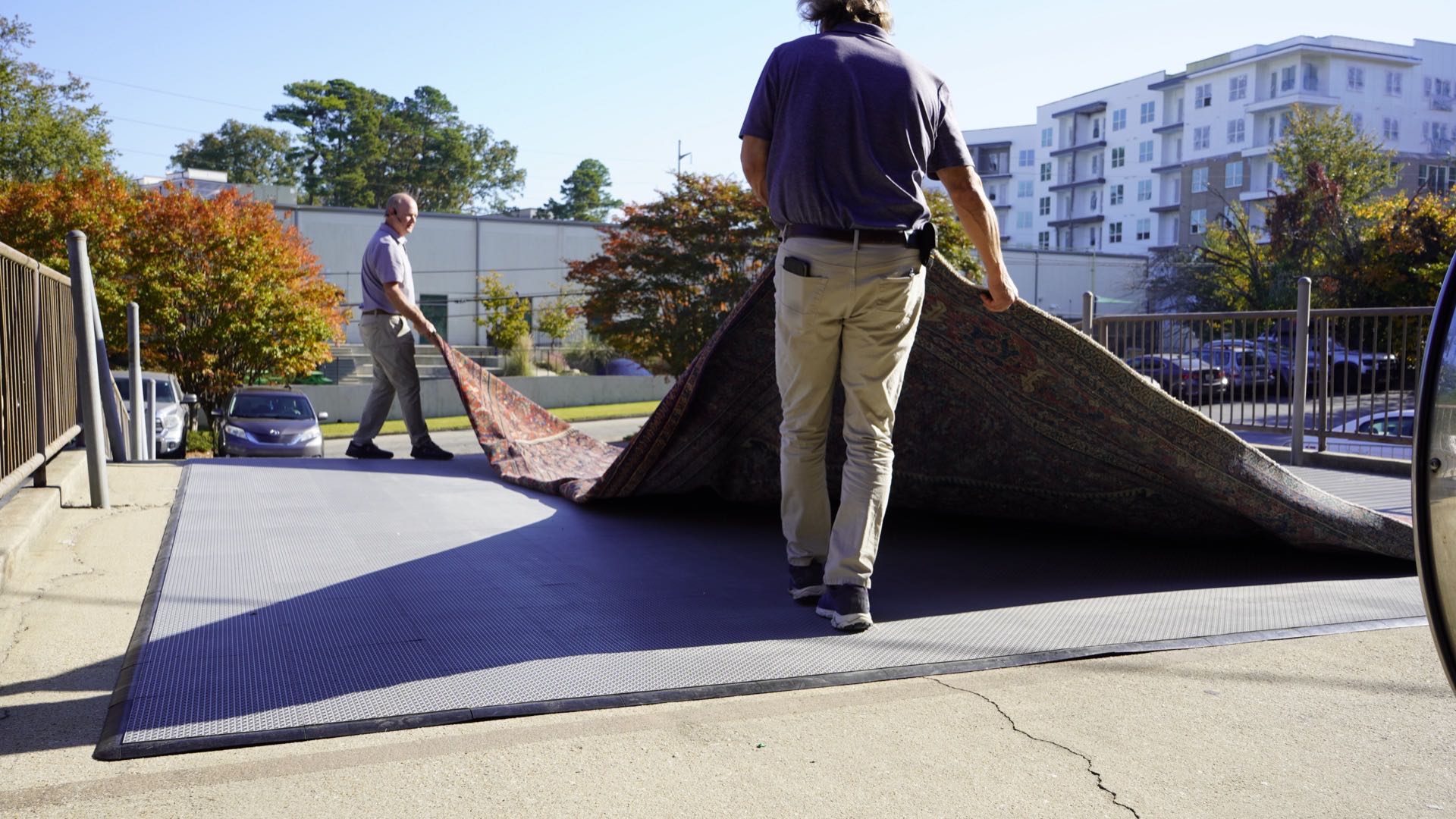
Rugs 8' x 10' and larger qualify for free pickup and delivery anywhere in metro Atlanta.
You should always get the scope, the timeline, and the price before work begins. That is how we run every job, and you can see the full workflow on our cleaning process page.
Budget $150 to $800 for most repairs, less for simple edge work, and more for reweaving fine or antique pieces. The price follows the hours, and the hours follow how the rug was made and how far the damage has spread.
The cheapest thing you can do today is find out where you stand. Request a free evaluation with photos of the damage, or call (404) 355-2126 — after 30 years of restoring Atlanta's rugs, we will tell you honestly whether yours is worth saving.
Common questions about rug repair prices in Atlanta
Send us photos of the damage and we'll tell you what it takes to fix it, what it will cost, and whether it's worth doing. Free pickup and delivery on rugs 8' x 10' and larger in metro Atlanta.

How often should you clean an Oriental rug? Learn the ideal cleaning schedule based on fiber type, traffic, and home conditions to preserve your rug's beauty.
Read MoreRug cleaning in Atlanta costs $2–$8 per sq ft. See prices by rug size, what drives the cost, and how to save — plus get a free quote from S&S Rug Cleaners.
Read MoreComplete guide to rug repair and restoration in Atlanta — antique repair, moth damage, fringe work, and when to restore vs replace. Expert advice from S&S.
Read More